Speaking the Safari Lingo: A Traveler's Guide to Safari Words and Phrases
From sundowners to the Big Five, learn the safari words you'll hear in camp and on game drives. A friendly guide to the terms, phrases, and a little Swahili that help you feel at home in the bush.
Speaking the Safari Lingo: A Traveler's Guide to Safari Words and Phrases
On your first evening in camp, someone offers you a sundowner. On your first game drive, your guide mentions a kopje, a dazzle, and a pair of dagga boys before you have even finished your coffee.
Safari has a language of its own. Some of it comes from Swahili, some from Afrikaans and isiZulu, and some from generations of guides and trackers sharing stories around the fire.
You don't need to learn it all before you go. But a few words make it easier to follow your guide, ask better questions, and feel part of the conversation. Here is a friendly starter vocabulary.
Why Learn the Safari Lingo?
Your guide's commentary is one of the richest parts of a safari. When you understand the terms, you hear more of the story: why a herd is restless, what a track means, or why everyone suddenly goes quiet.
A few local words also open doors. A simple "asante" or "thank you" in the local language is often met with a warm smile, and it shows respect for the people who host you.
And it's fun. By the end of your trip, you may find yourself calling every rocky hill a kopje.
Words You'll Hear on a Game Drive
Safari: The Swahili word for "journey." It comes from the Arabic safar, meaning to travel.
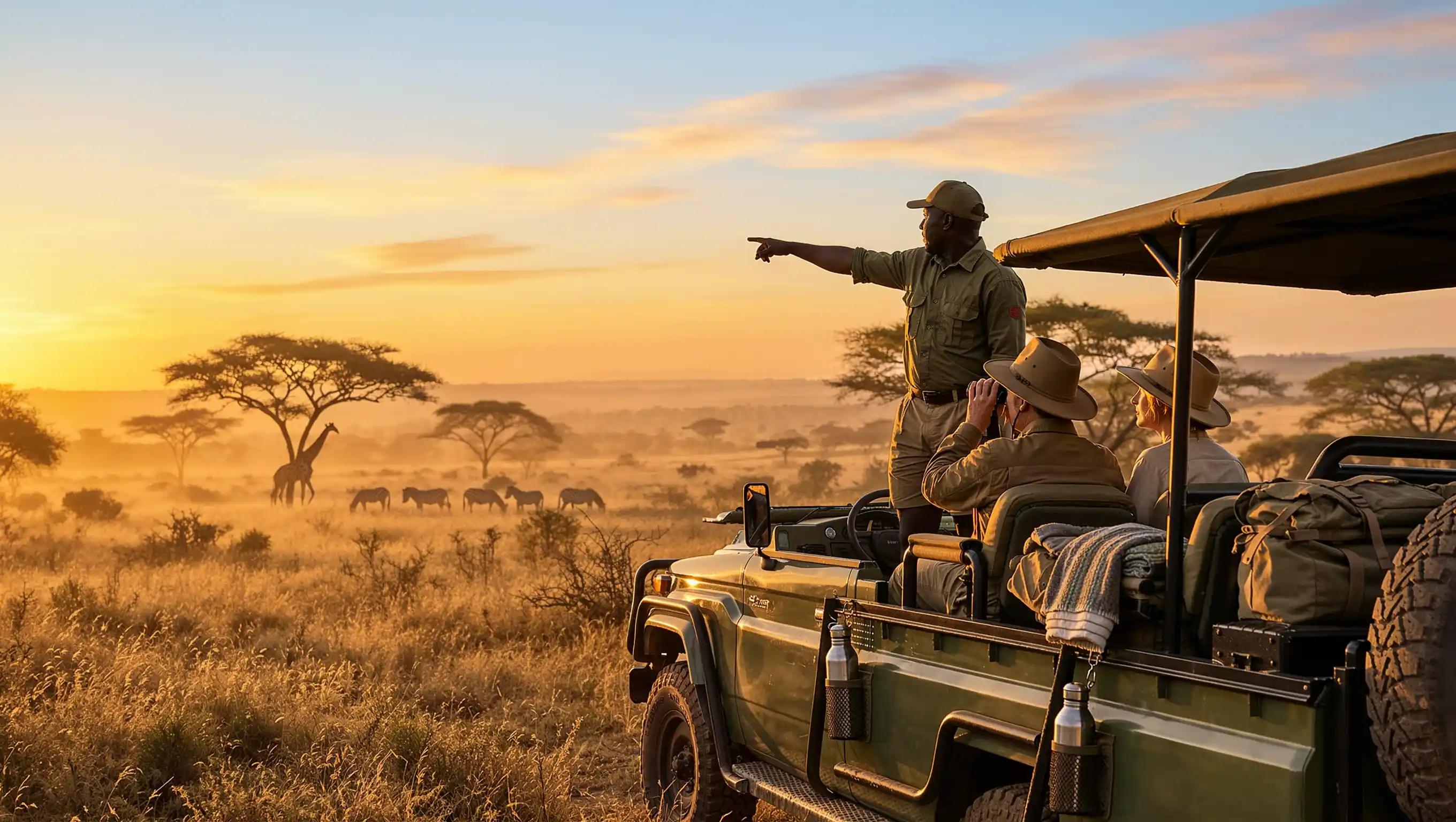
Game drive: A guided outing in an open or pop-top vehicle to look for wildlife. Most camps run one in the early morning and one in the late afternoon, when animals are most active.
Ranger, guide, and tracker: Your guide drives, interprets, and keeps you safe. At many Southern African lodges, a tracker sits on a seat at the front of the vehicle, reading tracks, dung, and broken branches.
Sighting: Any wildlife encounter worth stopping for. Guides often share sightings by radio, which is why your vehicle may suddenly change direction.
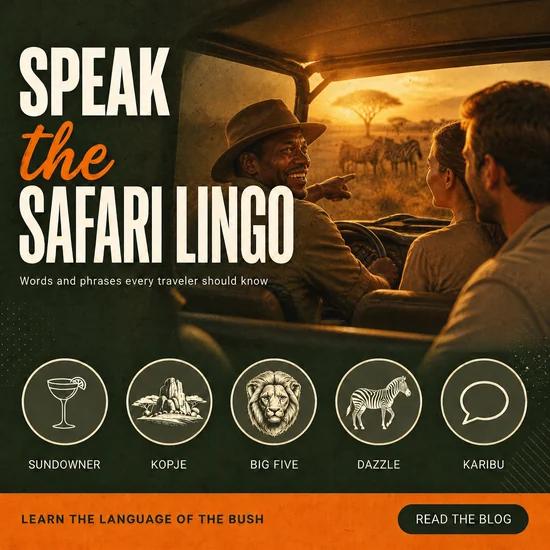
Sundowner: A drink enjoyed at a scenic spot as the sun sets, often with snacks laid out on the vehicle's bonnet. A gentle safari ritual.
Bush breakfast: Breakfast served outdoors in the wilderness, usually as a surprise stop after a morning drive.
Walking safari: Exploring on foot with an armed, qualified guide. You trade distance for detail: tracks, plants, insects, and the smaller stories of the bush.
Off-road driving: Leaving the track to approach a sighting. It is restricted in many national parks and permitted only under specific rules in some private reserves and conservancies.
Mokoro: A traditional dugout-style canoe used in Botswana's Okavango Delta. A poler stands at the back and guides you quietly through the channels.
Listen for it: "Hold on, we've got a sighting" usually means the next few minutes will be worth it.
The Famous Fives and Other Wildlife Terms
The Big Five: Lion, leopard, elephant, rhino, and Cape buffalo. The term began with hunters, who considered these the most dangerous animals to track on foot. Today, most travelers hope to see them through a camera lens.
The Little Five: A playful counterpart: the ant lion, leopard tortoise, elephant shrew, rhinoceros beetle, and buffalo weaver. Spotting them takes patience and a sharp-eyed guide.
The Ugly Five: Hyena, vulture, warthog, marabou stork, and wildebeest. Unglamorous, perhaps, but each plays an essential role in the ecosystem.
Dagga boys: Older male Cape buffalo that spend their days wallowing in mud. "Dagga" comes from the isiZulu word for mud. Guides treat them with great respect.
Plains game: Grazing and browsing animals such as zebra, giraffe, wildebeest, impala, and other antelope.
The Great Migration: The year-round movement of wildebeest, zebra, and gazelle through the Serengeti and Maasai Mara ecosystem. River crossings are spectacular, but timing is never guaranteed. Explore our Kenya safari page for more on the Mara.
Mock charge: A warning display, often by an elephant, with ears spread and head raised. Your guide will read the signals and keep a respectful distance.
LBJ: Birders' shorthand for a "little brown job," a small brown bird that is hard to identify.
Safari also has some delightful collective nouns:
- Pride: a group of lions
- Coalition: male cheetahs or lions that live and hunt together
- Tower: giraffes
- Dazzle: zebras
- Crash: rhinos
Landscape Words from the Bush
The bush: The general term for wild, natural areas. "Out in the bush" simply means away from towns.
Bushveld and lowveld: Southern African terms for savanna and woodland, often used around the Greater Kruger area. Our South Africa safari page explains more about the region.
Kopje (or koppie): A rocky granite outcrop rising from the plains, from the Afrikaans for "little head." Lions and leopards often use them as lookouts in the Serengeti.
Donga: A dry, eroded gully or ditch. Animals sometimes rest in them out of the wind.
Vlei: A shallow, seasonal wetland, pronounced "flay." Great places to watch birds and grazers.
Waterhole and pan: A waterhole is a natural or maintained water source. A pan is a shallow depression that fills with water after rain.
Boma: Originally a Swahili word for an enclosure. At many lodges, the boma is an open-air dining area around a fire, perfect for evening stories.
Concession and conservancy: Private or community-managed areas where camps operate under agreed rules. These often allow smaller vehicle numbers and activities such as night drives or guided walks.
Swahili Phrases to Practice
Swahili is widely spoken in Kenya and Tanzania. A few phrases go a long way:
- Jambo: Hello. A friendly, simple greeting, especially with visitors.
- Karibu: Welcome. You'll hear it often.
- Asante (sana): Thank you (very much).
- Pole pole: Slowly, slowly. A gentle reminder to relax into safari time.
- Hakuna matata: No worries.
- Rafiki: Friend.
- Mzee: A respectful term for an elder.
And a few animal names to listen for: simba (lion), tembo (elephant), twiga (giraffe), chui (leopard), kiboko (hippo), nyati (buffalo), duma (cheetah), and punda milia (zebra, literally "striped donkey").
Southern African Slang Worth Knowing
In South Africa, Botswana, and their neighbors, English is mixed with Afrikaans and local languages. A few favorites:
- Braai: A barbecue, and a social event in its own right.
- Lekker: Nice, great, delicious.
- Howzit: A casual "how are you?"
- Just now: Sometime soon. Possibly later. Not necessarily now.
- Now now: Sooner than "just now," but still relaxed.
- Eish: An expression of surprise or mild frustration.
If your guide says the vehicle will be ready "just now," there may be time for another coffee.
Using the Lingo with Respect
Language is a way to connect, not a performance. Try a greeting, ask how to pronounce a word, and listen to the answer. Most people are delighted when visitors make the effort.
Ask your guide about local names for animals and places. You'll often learn something about culture and history too.
Be thoughtful with photographs of people, and always ask first. When visiting communities, follow your hosts' lead. You can read more about how we approach responsible travel on our sustainable tourism page.
Bring It All Together
You can put your new vocabulary to work at every stage of the journey, from the first game drive to the final sundowner. For trip preparation, explore our Ultimate Safari Planning Guide.
Want to try a walking safari, a boma dinner, or a night under the stars? Our guide to safari add-ons and extensions has ideas.
Final Thoughts
You don't need fluent Swahili or perfect Afrikaans to enjoy a safari. A handful of words is enough to follow the story, share a laugh, and show respect.
Start with karibu, asante, and sundowner. The rest will come, pole pole, one game drive at a time.
By the end of your trip, you may find that the lingo is one of the souvenirs you bring home.
Ready to Put the Lingo to Use?
Tell Fair Trade Safaris where you'd like to go, when you'd like to travel, and what you hope to experience. We'll help shape a safari that feels personal from your first karibu.
Plan My SafariReady to share your thoughts?
We love hearing from mindful travelers. Leave a comment below.